
We are delighted to report a successful collaboration with Astrea Academy in Burngreave, where Harry Brearley was born. With help from Portland Works and Friends of Portland Works, the school designed and delivered a super Key stage 2 local history project. A grant from the Church Burgesses paid for educational materials and a school trip to the David Mellor factory and showrooms in Hathersage. We are hoping that other primary schools in Sheffield will want to run a similar local studies project. With that in mind, below is the project evaluation. Initial enquiries can be made to fopwchair@gmail.com
REVIEW OF THE ASTREA BURNGREAVE KEY STAGE 2 PROJECT: the story of how stainless steel was discovered and made into the world’s first cutlery.
BACKGROUND.
Friends of Portland Works proposed the project to the school. Two volunteers from the Works assisted by providing resources and funding from a £750.00 grant awarded by Sheffield Church Burgesses.
PREPARING THE GROUND
The following preparations were made to support the project:
- The two volunteers met with both the Headteacher Rachel Flemming and Lucy Hartley [history lead teacher] to explore the possible contribution to the stainless steel themed ‘immersion’ week.
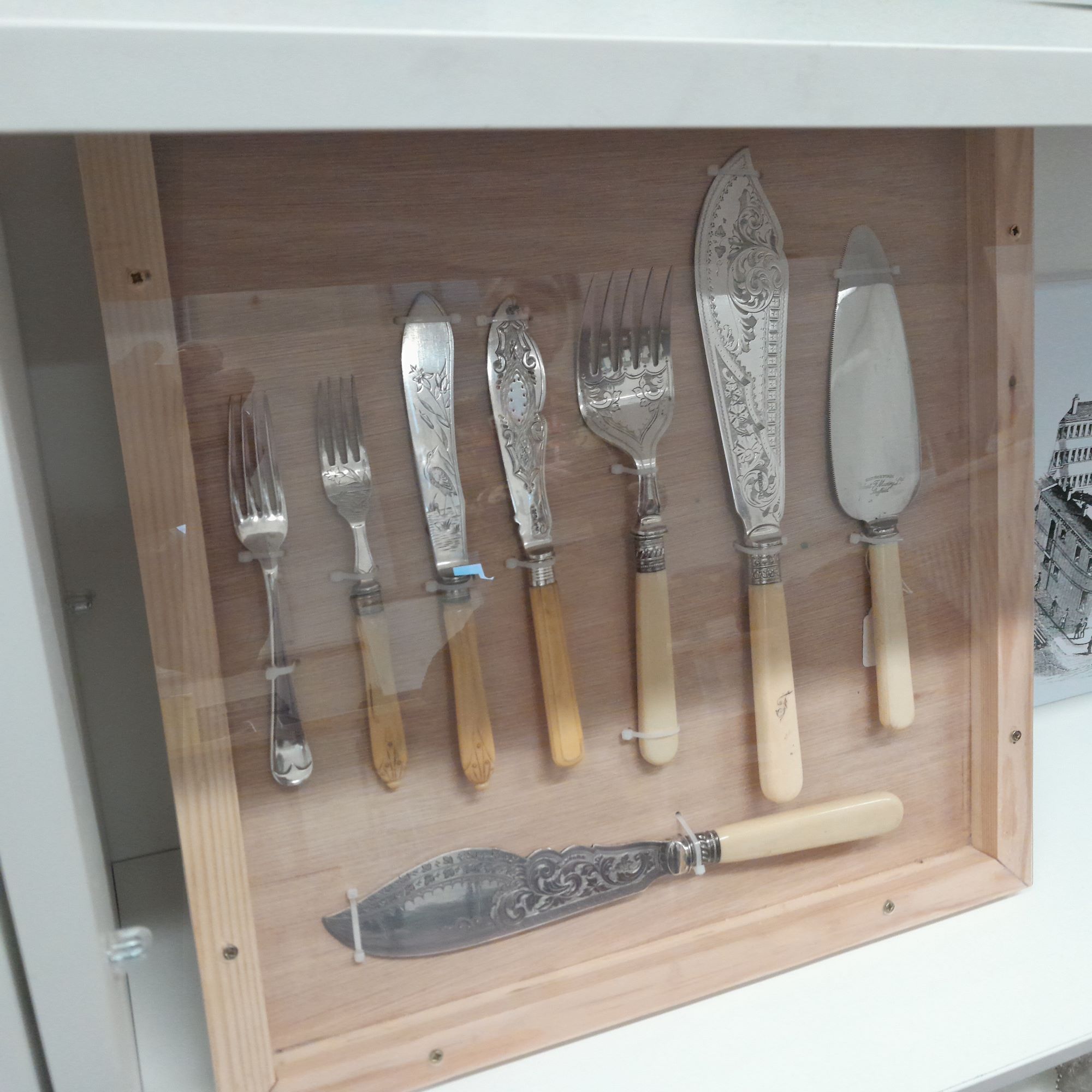
- Examples of cutlery were loaned by Portland Works and secured in custom-made cases that could be handled by the pupils, see photo. In addition, a selection of individual primary artefacts was chosen that the pupils could handle.
- Harry Brearley’s autobiographical notes were loaned to the school.
- The Cellar Lad by Theresa Tomlinson was recommended. Harry started working at a young age as a cellar lad. This secondary source, by a local author, follows the life of a cellar lad like Harry Brearley in the local setting of Sheffield.
- A set of eight A3 size mounted archive photos were provided, showing conditions at Portland Works in the early 20th
- David Mellor at Hathersage agreed to receive a school visit so that children could see a modern cutlery manufacturing facility.
- Outokumpu agreed to visit the school with illustrative materials explaining how stainless steel is manufactured.
Based on this material and personal research, Lucy Hartley (history lead teacher) developed a KS2 learning programme.
WORKING WITH THE PUPILS
The 27 pupils at Key stage 2 (ages 10-11) had an “immersion week” during which they learned about Harry Brearley who was born in Burngreave and how he worked with Ernest Stuart at Portland Works to create the world’s first stainless steel cutlery. The project took place during the summer term. The pupils gained insights into many aspects of life in the early 20th century. They learned about Harry Brearley’s humble beginnings in an overcrowded house in Burngreave; the working conditions in cutlery manufacturing, including health and safety hazards; the processes involved in making cutlery and its importance in the Sheffield economy; by being able to handle the artefacts they gained an appreciation of the craftsmanship, the materials and the uses of different types of table cutlery.
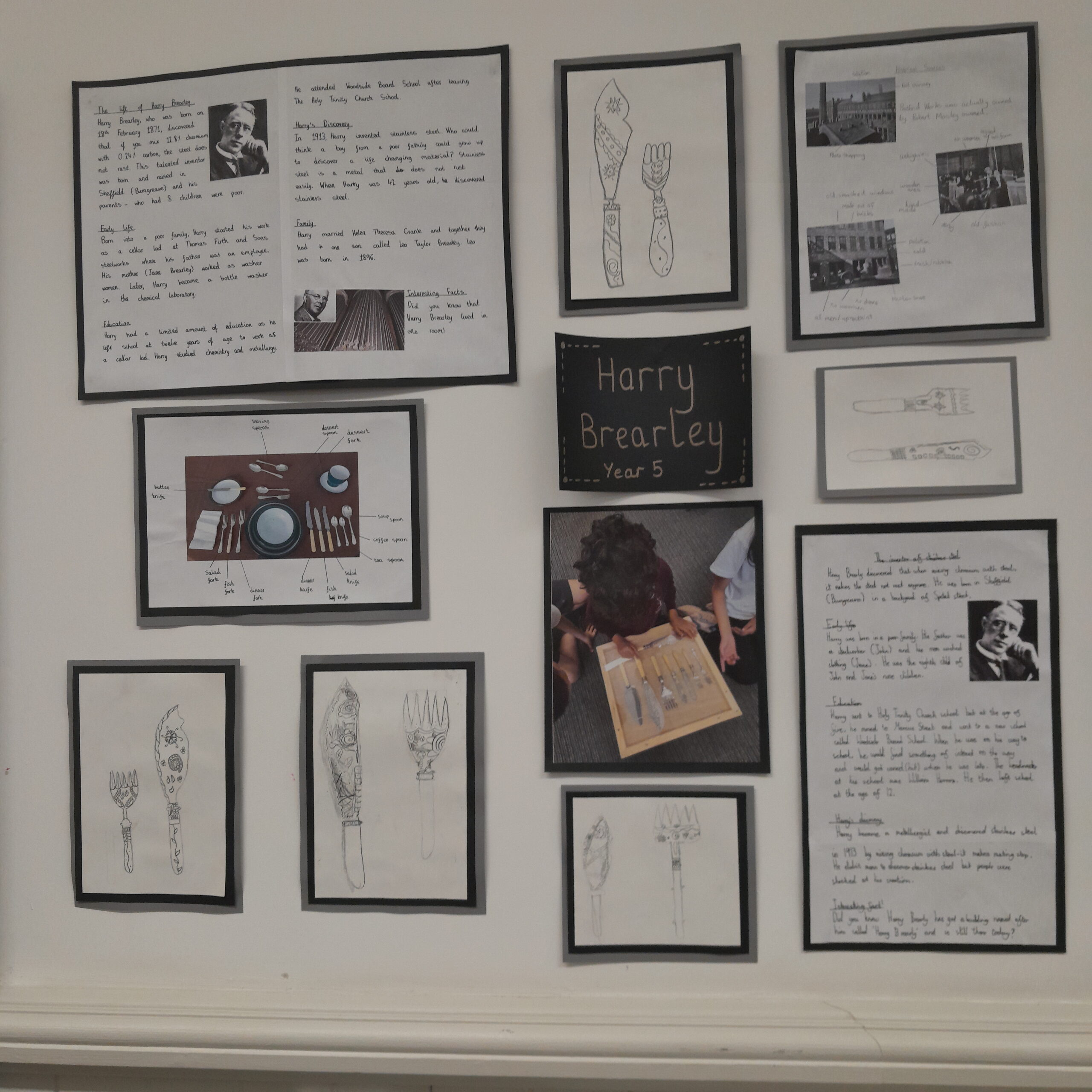
The pupils produced insightful artwork, annotated diagrams and written research demonstrating their new knowledge and this is on display in the Boardroom at the school alongside the loaned resources.
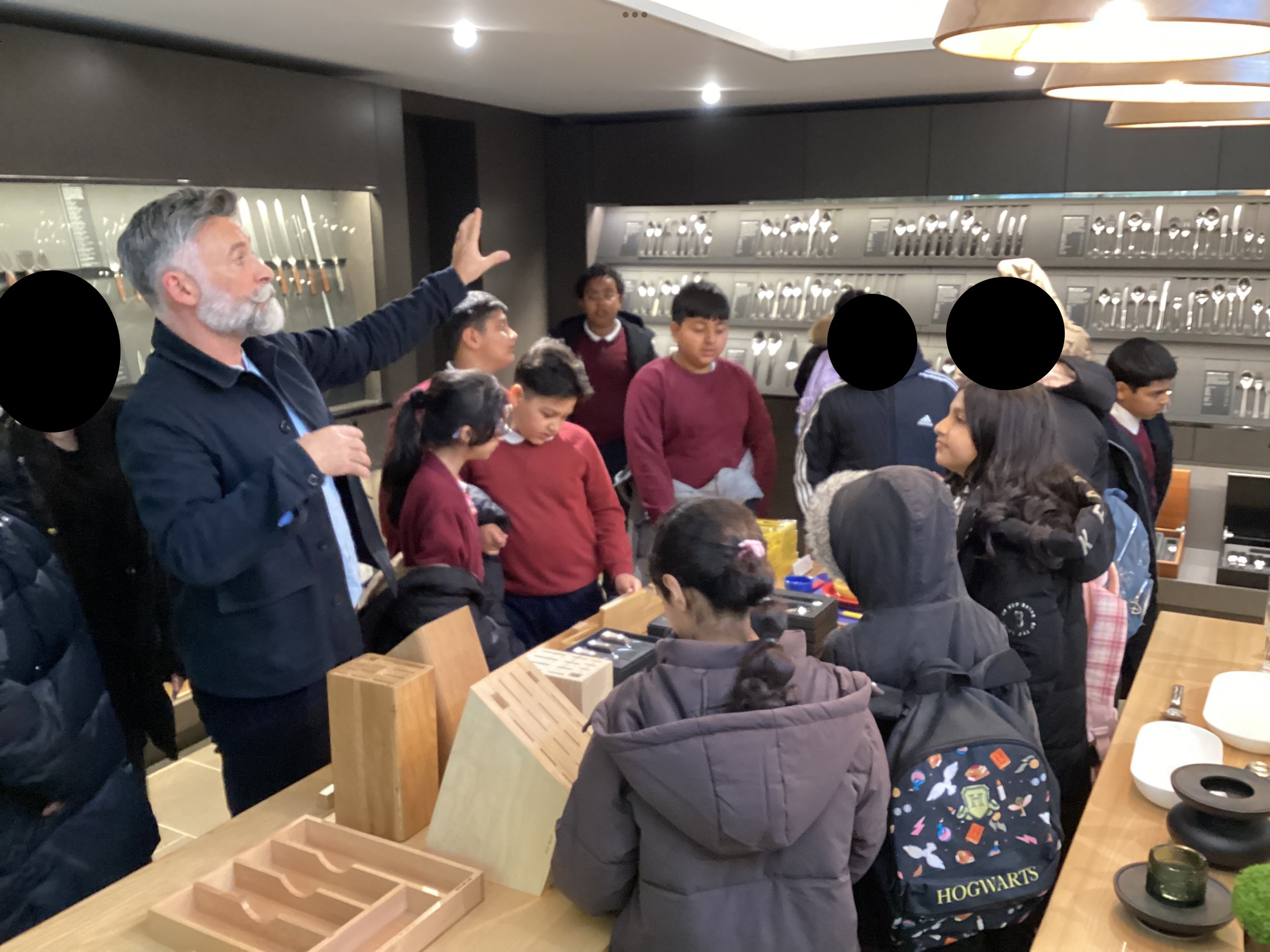
On 16th October the pupils visited David Mellor and were shown round by a senior member of staff. They saw the range of David Mellor products past and present and were given access to the factory where the production processes were explained. There were lots of questions from the pupils who were very actively engaged in finding out more. The David Mellor guide emphasised the importance of design and function and eloquently explained the impact of stainless steel and its wide application in the modern world. The accompanying teacher, Tim James helped to bring out the key learning points. The factory allows public access and shows a film on a loop showing the processes involved in making a fork.
EVALUATION
Charity trustees Paul Iseard and Stella Howe met with Lucy Hartley and Head Teacher Rachel Flemming on 9th December to review the project and share information about how it went. During the visit there was a group discussion with 8 of the pupils who spoke about what they had learned and enjoyed during the project. See also the photo below showing some of the work produced by the pupils.
The recall from the “immersion day” five months previously was very good. The pupils were able to talk about what they had learned and were keen to engage. They produced detailed artwork from the primary sources, demonstrated annotation skills and detailed written work from their research in class. Similarly, they were able to describe what they had discovered on the factory visit. It was heartening to hear that three of the pupils we spoke with had shared their learning with their families. It was inspiring to see the pupils engaged and with a positive attitude to learning.
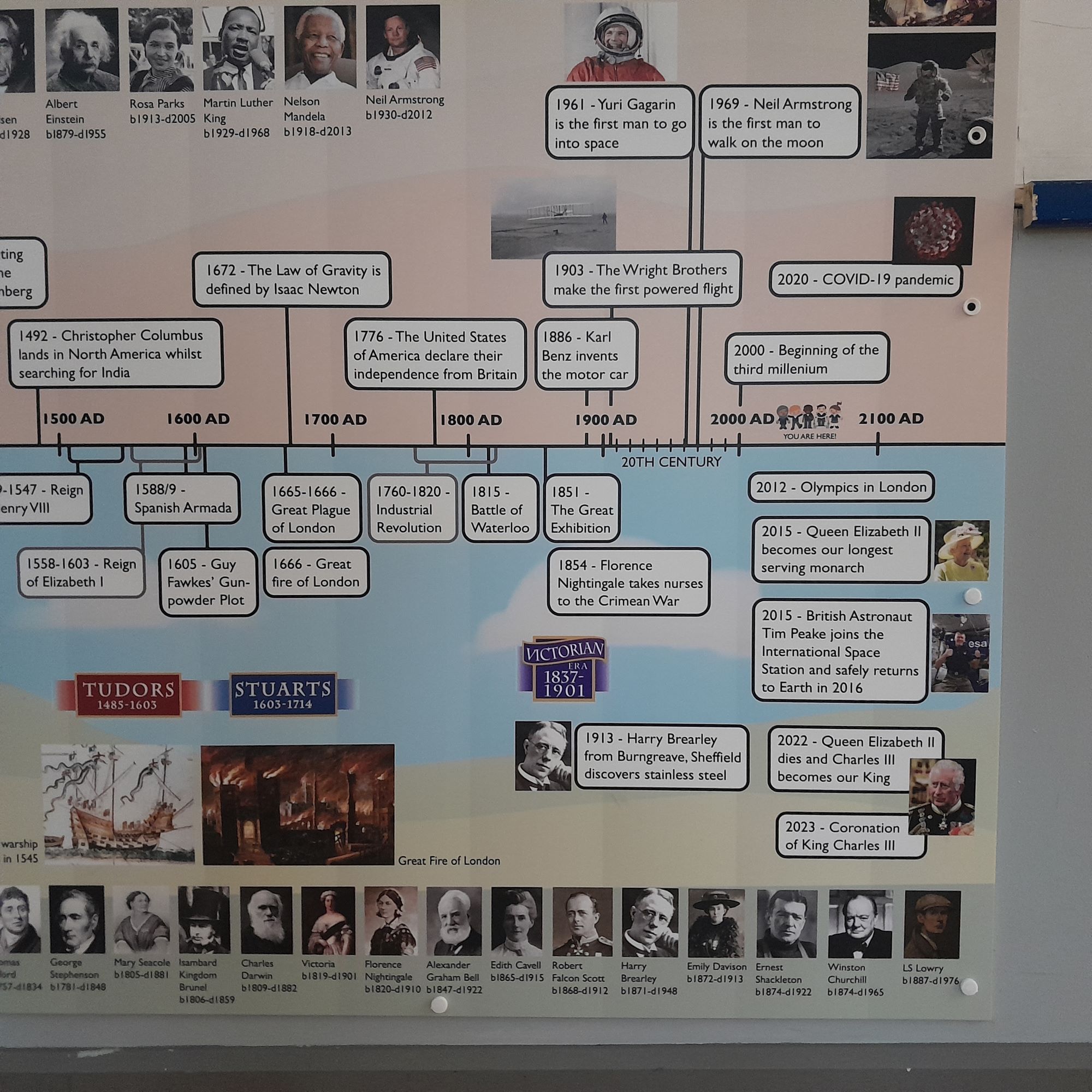
In addition, Harry Brearley has now been included on the impressive timeline the school has already developed to aid an understanding of chronology and significant historical events, see photo. The class teacher commented that the presence and support of the volunteers from Portland Works made an important contribution to the success of this project.
As a direct response to the project work the school has conducted a review of its history curriculum and added in a local study.
CONCLUSIONS
The project has been a great success, and the school will continue to use the Harry Brearley/Portland Works theme in the Local Studies at KS2. The key learning for this and future projects is:
- Hands-on artefacts and the historical works photos are critical to engaging the pupils (See photos below).
- Harry Brearley’s account of his early life has captured the imagination of the pupils.
- The creation of artwork and essays by the pupils amply demonstrates the learning benefits from the project (see photos below)
- The visit to David Mellor was exciting for the children and provided a unique opportunity to see a working cutlery factory.
WHAT NEXT?
Astrea Academy will be exploring how the project might be delivered at KS3.
Astrea have agreed to provide advice to other schools, and additional artefacts/resources can be assembled by Friends of Portland Works to enable other schools to run a similar KS2 project tailored to their requirements.
DECEMBER 2025